
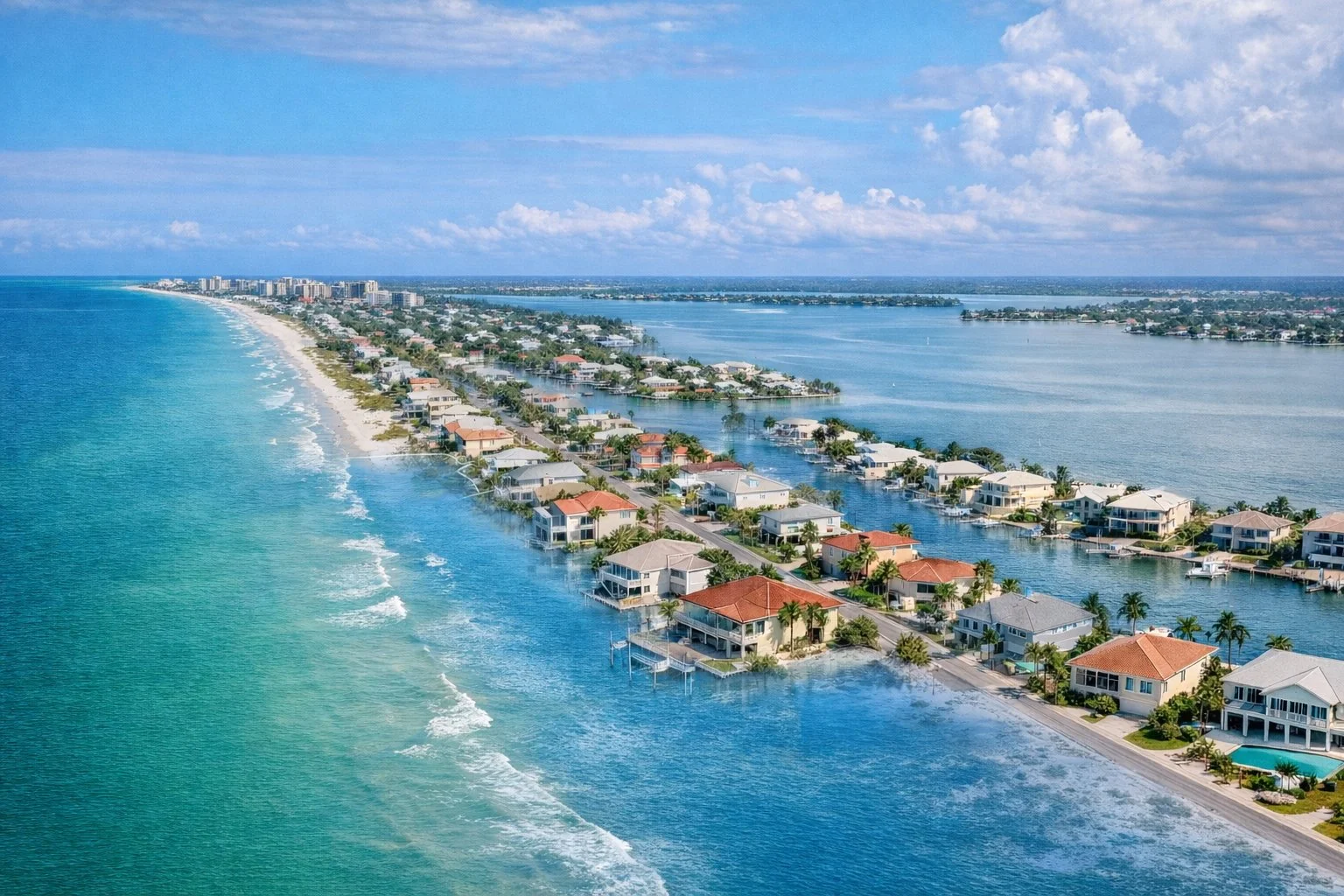
Florida Gulf Coast Flood Zones Explained: A Complete Guide for Buyers, Investors, and Owners
Published on GulfCoastPropertyReport.com | Data-driven insights for Florida's Gulf Coast real estate market
Why This Guide Exists
You've worked a long time for this. Whether you're buying a Gulf Coast home as your retirement destination, a second property you plan to enjoy now and pass on later, or an investment that supplements your income — the last thing you want is a financial surprise that nobody warned you about.
Flood zone designation is one of the most consequential — and most misunderstood — factors in Gulf Coast real estate. It affects your insurance costs, what your lender will approve, and increasingly, what a property is worth on the open market. On barrier islands like Clearwater Beach, Indian Rocks Beach, and Anna Maria Island, the difference between flood zone designations can mean thousands of dollars per year in carrying costs, and a very different experience if a major storm comes through.
This guide covers everything you need to know before you buy, make an offer, or commit to a Gulf Coast property: what FEMA flood zones are, what each designation means in real dollars and real risk, how they affect financing and insurance, and what the 2024 hurricane season taught us about the limits of what a zone label can and can't tell you.
What Is a FEMA Flood Zone?
The Federal Emergency Management Agency (FEMA) maintains Flood Insurance Rate Maps — called FIRMs — for communities across the United States. These maps divide land into zones based on the estimated probability of flooding in a given year, using historical storm data, hydrology studies, surge modeling, and topography.
The maps are used by lenders, insurers, and local governments to assess risk. They're also the foundation of the National Flood Insurance Program (NFIP), which provides flood insurance to property owners in participating communities — virtually every municipality along Florida's Gulf Coast participates.
Here's what's important to understand from the start: flood zone maps represent statistical risk based on modeling — not a guarantee of what will or won't flood. Zone X properties flooded in Hurricane Helene. Zone AE properties stayed dry. The map is a planning tool, not a promise.
That said, it's the single most important starting point for understanding a Gulf Coast property's risk profile, and no serious purchase decision should be made without it.
FEMA Flood Zone Designations Explained
FEMA uses a letter-based system to classify flood zones. Here's what each one means in plain language — and what it means for your budget and peace of mind.
| Zone | Risk Level | Insurance Required? | Common on Gulf Coast? | Key Watch-Out |
|---|---|---|---|---|
| VE | Highest | ✓ Yes (if financed) | Gulf-facing barrier island shores | Wave action exposure; highest premiums; strict build codes |
| AE | High | ✓ Yes (if financed) | Very common — coastal & inland waterways | Elevation certificate critical; BFE determines your premium |
| X — Shaded | Moderate | — Not required | Occasional pockets | 25% of NFIP claims come from moderate/low zones |
| X — Unshaded | Low | — Not required | Less common on barrier islands | Lower risk — not zero risk; surge can exceed modeled boundaries |
| A | High | ✓ Yes (if financed) | Rural & outlying areas | No Base Flood Elevation — harder to price insurance |
| D | Unknown | — Varies | Rare on Gulf Coast proper | Area unstudied; lenders treat cautiously |
* Insurance requirement applies to federally-backed mortgages (conventional, FHA, VA). Cash buyers face no lender mandate but carry the same underlying risk.
Zone VE — Coastal High Hazard Area
Risk level: Highest
Zone VE is FEMA's most severe coastal designation. It covers areas subject not just to flooding, but to wave action — specifically, breaking waves of three feet or greater hitting the structure directly. The "V" stands for velocity, referring to the destructive force of moving water under storm conditions.
On Florida's Gulf Coast, VE zones typically cover the beach-facing sides of barrier islands, gulf-front parcels, and areas within the most direct path of storm surge. If you're looking at a home on the gulf side of a barrier island, there's a meaningful chance it sits in a VE zone.
The practical implications are significant:
Flood insurance is mandatory for any financed purchase
Building codes are strict: structures must be elevated on open foundations — pilings or columns — not solid fill. Enclosed living space below the Base Flood Elevation is heavily restricted by code.
Insurance premiums are the highest of any designation
Replacement and repair costs are higher due to construction requirements, which also affects what you'd receive from a claim
For buyers approaching or in retirement, VE designation deserves careful attention beyond just the purchase price. The annual insurance cost and the exposure in a major storm event need to be factored into your long-term budget — and if you intend to pass the property to your children, into theirs as well. If you're a cash buyer (as many Gulf Coast retirement purchasers are), flood insurance is your choice rather than a lender's requirement — but skipping it on a VE-zone property is a risk very few financial advisors would endorse.
Zone AE — High-Risk Flood Area with Base Flood Elevation
Risk level: High
Zone AE is the most common high-risk designation you'll encounter in Gulf Coast markets. It identifies areas with a 1% annual probability of flooding — often called the "100-year flood plain," though that phrase misleads many buyers into a false sense of rarity. A 1% annual chance means that over 20 years of ownership, there's roughly a 1-in-5 chance of experiencing a base flood event.
The "E" in AE means that FEMA has established a Base Flood Elevation (BFE) for that location — the elevation, measured in feet above sea level, at or above which floodwaters are expected to rise during a base flood event. That BFE number is foundational: it drives building codes, insurance rates, and the critical importance of the elevation certificate.
Key facts for AE-zone buyers:
Flood insurance is mandatory for financed purchases (conventional, FHA, VA loans)
How high the home sits relative to the BFE matters enormously — a home built one or two feet above the BFE will carry substantially lower insurance premiums than one built at or below it
Elevation certificates are your best friend: this document, prepared by a licensed surveyor, establishes exactly where your structure sits relative to the BFE. Always ask whether one exists before making an offer — and if it doesn't, consider having one done before closing
AE zones aren't just beachfront — many inland Gulf Coast neighborhoods and waterway-adjacent properties carry AE designations
For buyers on a fixed retirement income, the annual insurance cost in an AE zone is a number you want confirmed — not estimated — before you fall in love with a property. Get an actual insurance quote based on the specific address and elevation certificate, not a rough guess.
Zone X (Shaded and Unshaded) — Moderate to Minimal Risk
Risk level: Moderate (shaded) to Low (unshaded)
Zone X is the designation most buyers hope to see. It indicates areas outside the 100-year flood plain — either moderate risk (shaded X, with a 0.2% annual chance of flooding) or minimal risk (unshaded X).
Federal lenders do not require flood insurance in Zone X, which represents a meaningful difference in annual carrying costs. But there are important nuances:
Roughly 25% of all NFIP flood insurance claims nationwide come from properties in moderate- or low-risk zones — flooding doesn't respect zone boundaries when surge exceeds projections
Flood zone maps are updated periodically; a Zone X property today could be reclassified in a future FIRM study, which would change insurance requirements and potentially affect resale value
Gulf Coast Zone X properties can still experience flooding from heavy rainfall, overwhelmed drainage systems, and storm surge that pushes beyond modeled boundaries
Zone X is a genuine advantage in both ownership cost and marketability. Many buyers relocating from higher-cost markets find that a Zone X Gulf Coast property, even with homeowners insurance factored in, is significantly less expensive to carry than what they left behind. Just don't treat it as a "no risk" designation — treat it as "meaningfully lower risk."
Zone A (Without BFE) — High Risk, Limited Data
Zone A carries the same 1% annual flood probability as AE, but without a specific Base Flood Elevation established by FEMA. You're less likely to encounter this on the developed Gulf Coast — where mapping tends to be detailed — and more likely to see it in rural or outlying areas. Lenders and insurers treat it as high risk and require flood insurance accordingly.
Zone D — Undetermined Risk
Zone D means the area simply hasn't been studied. Flood risk is possible but unquantified. This designation is rarely seen along the Gulf Coast proper, but can appear in outlying areas. Lenders treat it cautiously, and insurance is difficult to price without additional data.
- Flood insurance mandatory if financed
- Subject to wave action (3 ft+), not just flooding
- Must be built on pilings — no slab foundations
- Highest premiums of any designation
- Primarily gulf-facing barrier island properties
- Flood insurance mandatory if financed
- 1% annual probability = 1-in-5 over 20 years
- Base Flood Elevation (BFE) established for the area
- Elevation certificate can significantly cut premiums
- Most common high-risk zone on the Gulf Coast
- Flood insurance not required by lenders
- Outside the 100-year flood plain
- 25% of NFIP claims come from X-zone properties
- Maps can change — reclassification is possible
- Real cost advantage vs. AE & VE properties
How to Look Up Any Property's Flood Zone
FEMA provides a free, publicly accessible tool for this — the FEMA Flood Map Service Center at msc.fema.gov.
Here's how to use it:
Go to msc.fema.gov on any web browser
Type the property's full address into the search bar and press Enter
The site will display the property on a flood zone map
The color-coded zone where the property sits is its FEMA designation
If navigating the FEMA site feels cumbersome, don't hesitate to ask your real estate agent, title company, or lender to pull the official flood zone determination for you — they do this as a routine part of every transaction, and a certified determination is more legally reliable than the map viewer in any case.
One important note: the FEMA map shows the currently mapped zone. If a Letter of Map Amendment (LOMA) or Letter of Map Revision (LOMR) has been filed for the property — which can happen when a homeowner successfully demonstrates their land is higher than the map suggests — the official zone may differ from what the base map shows. Your title company or lender can confirm the current certified designation.
Also worth knowing: Pinellas County has undergone multiple flood map updates in recent years, reclassifying some properties in both directions. The effective date of the map matters.
How Flood Zones Affect Your Mortgage
If you're financing the purchase with a federally-backed loan and the property sits in a high-risk zone (AE or VE), flood insurance is a mandatory loan condition — not optional. This applies to:
Conventional loans purchased by Fannie Mae or Freddie Mac
FHA loans
VA loans
Your lender will order a certified flood zone determination through a third-party service as part of the loan process. If you're not maintaining flood insurance on a property in a mandatory zone, your lender can force-place a policy on your behalf — typically at rates considerably higher than what you'd pay shopping independently.
A note for cash buyers: A significant portion of Gulf Coast retirement and second-home purchases are made without financing, particularly among buyers who are selling a long-held primary residence in a higher-cost market. If that's your situation, no lender will require flood insurance — but the risk still exists. On a $600,000 or $900,000 gulf-front property, carrying flood insurance is basic asset protection. The question isn't whether you can afford the premium. It's whether you can absorb the loss without it.
For buyers considering a jumbo loan — common for higher-value coastal properties — lender requirements and underwriting standards can vary. Confirm flood insurance requirements with your lender early in the process, not at the closing table.
How Flood Zones Affect Insurance Costs
This is where the real financial impact lands — and where Gulf Coast buyers need to do detailed homework before making an offer, not after.
The National Flood Insurance Program (NFIP)
The NFIP is the federal flood insurance program administered by FEMA. It was for decades the only source of flood coverage most Gulf Coast homeowners could access.
NFIP policies provide up to $250,000 in structure coverage and $100,000 for personal contents. For buyers purchasing higher-value properties — which is common in coastal Gulf Coast markets — those caps are worth noting. A $900,000 beach home is substantially underinsured for structural replacement if the NFIP is the only policy in place. Excess flood coverage through private carriers can fill that gap.
A significant change to NFIP pricing came with FEMA's Risk Rating 2.0, rolled out beginning in 2021. The old system priced policies primarily on flood zone and the structure's elevation relative to BFE. Risk Rating 2.0 shifted to a more individualized model, factoring in:
Distance from water sources
The type and frequency of flooding the property faces
The cost to rebuild the structure
Foundation type and first-floor height
The result: some properties saw modest decreases, but many Gulf Coast properties — particularly those in coastal zones — saw meaningful increases. For buyers on fixed or semi-fixed retirement income, the unpredictability of future NFIP rate changes is itself a planning consideration. Rates have generally trended upward and are expected to continue doing so as FEMA works to align premiums with actuarial risk.
Private Flood Insurance
The private flood market in Florida has expanded considerably in recent years, and it deserves a close look alongside NFIP. Advantages of private flood policies can include:
Coverage limits well above the NFIP's $250,000 structural cap — critical for higher-value properties
Competitive premiums for many risk profiles, particularly for newer construction or well-elevated homes
Broader coverage terms in some policies
Shorter waiting periods — NFIP typically imposes a 30-day waiting period before coverage takes effect, while private carriers sometimes offer shorter windows
Given Florida's broader homeowners insurance difficulties — with several carriers having exited the state and Citizens Insurance becoming the insurer of last resort for many coastal homeowners — the private flood market is an important option to explore. Getting quotes from both NFIP and private carriers before you commit to a property is strongly recommended.
The Elevation Certificate: A Hidden Savings Opportunity
An elevation certificate is a document prepared by a licensed surveyor or engineer that establishes exactly how high your structure sits relative to the Base Flood Elevation. For properties in AE zones, this number can dramatically change what you pay for flood insurance.
A home that sits two feet above the BFE may pay hundreds of dollars less per year — sometimes significantly more — than an identical home at or below the BFE. If you're purchasing an AE-zone property, always ask whether an elevation certificate already exists for the home. If not, commissioning one (typically a few hundred dollars) before closing can lock in lower insurance costs for as long as you own the property — and make the home more attractive to future buyers as well. For a full walkthrough, see the complete guide: What Is an Elevation Certificate and Why Does It Matter?
Barrier Islands: A Special Case
Everything covered above applies to Gulf Coast properties broadly, but barrier islands deserve a separate conversation — because their risk profile is fundamentally different.
Barrier islands are narrow strips of land separated from the mainland by bays, lagoons, and intracoastal waterways. They are dynamic landforms, shaped continuously by wave energy, and they sit in direct storm surge exposure on two sides.
What that means practically:
Surge exposure is bilateral. During a major hurricane, water doesn't come only from the gulf side. Storm surge can push through the bay as well, and water can meet in the middle — a phenomenon that creates flooding in properties that a storm track analysis alone wouldn't predict.
Evacuation is mandatory and early. Barrier islands throughout the Gulf Coast region fall within Evacuation Zone A — Florida's highest-priority evacuation designation. If you're planning to use a barrier island property as a primary residence or spend extended time there seasonally, having a clear evacuation plan isn't optional. Families who've done it know: waiting too long means sitting in traffic when you should already be gone.
High-risk flood zones are the rule, not the exception. On most Gulf Coast barrier islands, VE and AE zone coverage is the norm. Zone X pockets exist but are relatively uncommon. Understanding this upfront prevents sticker shock when insurance quotes arrive.
Rebuild requirements can intensify after a major event. Florida's "substantial damage" rule means that if storm or flood damage requires repairs exceeding 50% of a structure's pre-damage assessed value, the entire building must be brought into current code compliance — which, for older homes on barrier islands, can be a very large and unexpected expense. This is worth understanding if you're looking at older construction.
None of this should discourage barrier island purchases outright. The Gulf Coast barrier island lifestyle — the beaches, the sunsets, the pace — is genuinely compelling, and those qualities drive real demand and sustained property values. But the purchase requires clear-eyed due diligence, and the ongoing costs need to be part of your retirement financial plan, not a surprise discovered after closing. If you're considering elevating an existing barrier island home to reduce risk and premiums, see: Elevating Your Home in Pinellas County.
What Recent Storms Taught Us
The 2024 hurricane season offered a sobering reminder: flood zone maps are risk models, not guarantees.
Hurricane Helene's storm surge in late September 2024 pushed water into parts of the Tampa Bay region that hadn't seen flooding in living memory — including neighborhoods in Zone X with no prior flood loss history. The surge scale defied what many longtime residents and property owners had assumed about their risk, based on decades without a major direct hit.
Hurricane Milton followed just two weeks later, reinforcing the same lesson from a different angle. Storm track, intensity at landfall, the timing relative to tidal cycles, and local geography can all push outcomes well beyond what any flood zone designation suggests.
For buyers, the takeaway is not panic — it's depth of inquiry. Flood zone is a critical first layer, but a complete picture also includes:
Flood claim history on the specific property — requestable through FEMA's NFIP flood claim history process, and sometimes obtainable through your insurance agent
Local knowledge about which streets and neighborhoods fill first — and how quickly they drain
The property's actual elevation above sea level, not just relative to BFE
What mitigation measures are in place — flood vents, proper grading, storm shutters, elevated mechanicals — and what condition they're in
Buyers relocating to the Gulf Coast from out of state often don't have this local knowledge yet. That's exactly why working with professionals who are embedded in these specific markets is so valuable.
Working with the Right Professionals
Flood zone due diligence isn't a solo project. Several specialists can make an enormous difference in how well you understand what you're purchasing — and what it will cost to own.
A licensed surveyor can prepare an elevation certificate and tell you precisely where your structure sits relative to the Base Flood Elevation — the number that most directly affects your NFIP premiums.
A flood zone specialist or LOMA consultant can evaluate whether a property may have been incorrectly mapped and, if so, help you pursue a Letter of Map Amendment that could change the official designation — and reduce mandatory insurance requirements.
An independent insurance agent with Florida coastal expertise is worth their weight in gold. They can shop both NFIP and private flood carriers, help you understand the gap between the NFIP cap and your property's replacement cost, and model the long-term insurance picture before you commit.
A financial planner familiar with Florida coastal real estate can help you integrate flood insurance costs, potential assessments, and insurance volatility into your broader retirement income picture. For buyers on fixed income, this is not a minor consideration — insurance costs in coastal Florida can shift materially from year to year.
A local real estate agent with deep Gulf Coast market experience is irreplaceable for understanding which specific neighborhoods and streets have flooded, how flood zone affects pricing and days on market in a given area, what the current insurance market looks like for specific properties, and how to make all of this work in your favor during negotiation.
If you're exploring Gulf Coast real estate from out of state — or simply want a warm introduction to experienced local professionals who specialize in coastal and barrier island properties — I'm happy to make that connection. As a licensed real estate broker, I maintain working relationships with specialists across the Gulf Coast market and regularly connect buyers and investors with the right local expertise. [Reach out here] to start that conversation.
The Bottom Line
Flood zone designation isn't a footnote in Gulf Coast real estate — it's a central factor that shapes insurance costs, financing, long-term affordability, and the value of what you're leaving behind for the people you care about.
The key takeaways:
Zone VE is the highest-risk coastal designation, covering areas subject to wave action. Expect mandatory flood insurance if financed, strict building requirements, and the highest annual premiums. Factor this into your long-term budget and estate planning.
Zone AE is the most common high-risk designation across Gulf Coast markets. Insurance is required for financed purchases. The elevation certificate and Base Flood Elevation are the numbers that matter most — always get them before committing.
Zone X represents meaningfully lower risk and lower carrying costs, but is not zero risk. Even without a lender requirement, flood insurance is worth considering — especially for your primary retirement home or a high-value second property.
Elevation certificates can significantly reduce NFIP premiums for AE-zone properties. Always ask whether one exists.
The NFIP's $250,000 structural cap is insufficient for most higher-value coastal properties. Private flood insurance or excess coverage is worth exploring.
Cash buyers face no lender mandate — but skipping flood insurance on a coastal Florida property is a risk very few financial advisors would recommend.
Barrier islands have a distinct and elevated risk profile. Bilateral surge exposure, mandatory evacuation zones, and substantial damage rules all deserve attention before purchase.
Flood maps are models — the 2024 storm season demonstrated clearly that the zone label doesn't fully capture what can happen in a significant event.
This guide is the hub of an ongoing series on flood-zone and coastal-insurance topics. Companion guides now available cover elevation certificates and home elevation in Pinellas County,with dedicated posts on NFIP vs. private flood insurance, Florida's homeowners insurance landscape, and lessons from the 2024 storms publishing in the coming weeks.
Gulf Coast Property Report provides data-driven real estate market insights for buyers, sellers, and investors across Florida's Gulf Coast. Content is informational in nature and does not constitute real estate, legal, or financial advice.
Related Guides:
What Is an Elevation Certificate and Why Does It Matter? — the single most important document for AE-zone buyers
Elevating Your Home in Pinellas County — cost, permits, and grant programs
STR Rules by City — useful for investors buying a coastal rental
Foreclosure Opportunities on the Gulf Coast — distressed property considerations in coastal markets
Coming in the series: How to Look Up a Property's FEMA Flood Zone in 3 Minutes · NFIP vs. Private Flood Insurance · Florida's Insurance Crisis · What Helene and Milton Taught Us