
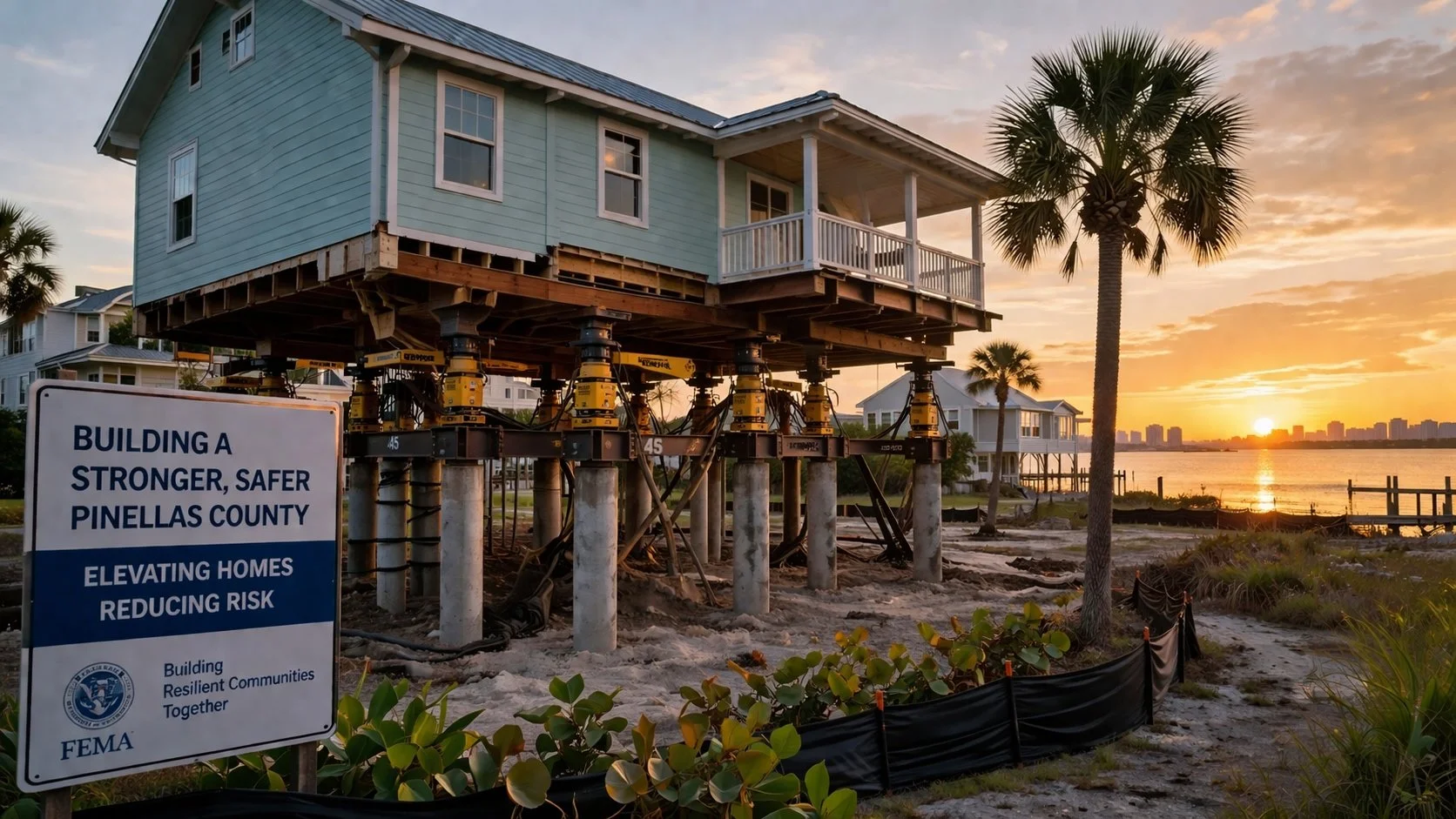
Lifting the Coast: What Pinellas County’s Barrier Island Homeowners Are Actually Experiencing with FEMA Elevation Programs
Barrier Island Guides — Research Current as of April 2026 — Covering the FEMA 50% Rule, Elevate Florida, HMGP/FMA, ICC Coverage, and the Permit Environment Across Pinellas County
After Hurricanes Helene and Milton tore through Pinellas County’s barrier islands in fall 2024, thousands of homeowners were told the path forward was clear: get a substantial damage determination, apply for elevation assistance, and use one of several state and federal programs to lift your home above the floodplain.
Eighteen months later, the reality on the ground looks considerably different from the official program descriptions. This report lays out what the programs actually are and how they are supposed to work — and just as importantly, what homeowners are actually experiencing right now. No sensationalism. Just an honest accounting.
The Starting Point: Understanding the FEMA 50% Rule
Before getting into the programs, the rule driving all of it needs to be understood clearly.
The Definition
Substantial Damage means the cost to restore a structure to its pre-damaged condition equals or exceeds 50% of the structure’s pre-damage market value — excluding land value. Building only. Not lot value.1
Who Determines It
Your city or county building/community development department issues Substantial Damage Determinations (SDDs). Post-Helene, Pinellas County and its municipalities contracted with Tidal Basin to conduct inspections across thousands of properties simultaneously.2 The structure value used in the calculation comes from the Pinellas County Property Appraiser’s FEMA/WLM Letter, accessible at pcpao.gov.3
What It Triggers
If your home is determined to be substantially damaged, you cannot simply repair it to pre-storm condition. You must bring the entire structure into current floodplain compliance before permits can be issued — which means elevating to or above the Base Flood Elevation, plus any additional freeboard required by your specific municipality.4
What Homeowners Are Reporting About the Determination Process
This is where the first significant gap between official process and real experience emerged. Many homeowners in Treasure Island, St. Pete Beach, Madeira Beach, and Indian Rocks Beach reported receiving SDD letters with damage estimates they believed were dramatically overstated. One Pinellas County certified building contractor described a situation where FEMA’s automated estimating tool calculated $81,000 in repairs on a home where he estimated less than $20,000 in actual damage. “This process is far more agonizing and hurting than the actual flood,” he said.5
Others reported receiving two different damage assessments on the same property — one completed, one not — that conflicted with each other. City staff, in many cases, were working 60-hour weeks and struggling to keep pace with the volume of emails from residents.6
Elevate Florida: Official Description vs. What’s Actually Happening
What the Program Says It Is
Launched in early 2025, Elevate Florida is Florida’s first statewide residential mitigation program. The Florida Division of Emergency Management (FDEM) positioned it as a faster, more homeowner-friendly alternative to the traditional federal grant process. Key features as officially described:9
- Federal grant funding covers at least 75% of project costs; homeowners pay up to 25%
- Four project types: Structure Elevation, Mitigation Reconstruction, Wind Mitigation, and Acquisition/Demolition
- A projected timeline of 2–6 months from application to start of construction
- Homeowners apply directly to the state — no need to go through local government
- Temporary relocation costs covered for elevation and reconstruction projects
- Funding cap for mitigation reconstruction raised to $375,000 in September 202510
On paper, it was a compelling program. And for Pinellas County homeowners devastated by Helene and Milton, it created significant hope. About 40% of all statewide Elevate Florida applications — roughly 3,678 in Pinellas County alone — came from this one county.11
What’s Actually Happening as of April 2026
Of the more than 12,000 Floridians who applied statewide, approximately 90% were denied or dropped out in the first round. The program targeted 2,000 homes with a $400 million budget. Simple math: the gap between demand and capacity was enormous from day one.12
But the more pressing issue isn’t the denial rate — it’s what happened to the homeowners who were accepted.
What’s Actually Causing the Delays
The reason is a federal approval bottleneck that the state itself described as “unanticipated.”15 Here is what is actually causing it, as documented in state emails and public reporting:
- FEMA must individually approve each project before federal funding can be released. The state does not control this step. Applications move from FDEM to FEMA, where they wait in a queue.16
- A DHS policy implemented in summer 2025 by then-Secretary Kristi Noem required her personal review and approval of any DHS grant or contract award over $100,000. Since elevation projects routinely exceed that threshold, nearly every Elevate Florida project was funneled into this additional approval layer. At least 1,034 FEMA grants, contracts, or disaster assistance awards had been delayed or left pending under this review process.17
- FEMA staffing reductions and a partial federal government shutdown in early 2026 further paused non-emergency recovery work. FEMA confirmed that elevation projects fall under non-emergency recovery work.18
- Funding may not have formally arrived. Multiple reports indicate the state received a “notice of intent” to award funds, but not the actual money. One Shore Acres homeowner received written notice that FEMA funds had been on hold since June 2025.19
The political situation began to shift with Noem’s departure from DHS in spring 2026 and new DHS Secretary Markwayne Mullin signaling intent to eliminate the $100,000 review threshold during his confirmation hearing.20 As of mid-March 2026, a small number of Elevate Florida projects had reportedly begun receiving approvals.21 But for families living in RVs in their driveways, paying rent plus a mortgage on an uninhabitable home, or watching FEMA rental assistance expire, the program’s promise had not yet translated into results.
Bottom line on Elevate Florida
It remains a real program with real funding — and some homeowners are beginning to receive approvals as of April 2026. But the projected 2–6 month timeline from application to construction start has not materialized for the vast majority of accepted applicants. A more realistic expectation, based on documented experience, is 18 months to 3 years from application to completed construction.
Other Federal & Insurance-Based Elevation Programs
FEMA Flood Mitigation Assistance (FMA) and Hazard Mitigation Grant Program (HMGP)
What the programs say: FMA is a federally funded, nationally competitive annual grant program. HMGP activates after a federal disaster declaration. Both require homeowners to apply through local government, not directly to FEMA.24
Reality check: These programs have historically operated on timelines measured in years. Elevate Florida was designed in part to solve exactly this bottleneck. Given that Elevate Florida itself has stalled, homeowners who bypassed FMA and HMGP to pursue Elevate Florida are now in a complicated position. Neither pathway is moving quickly, and the federal funding environment for disaster recovery has become less predictable since 2025. A meaningful number of accepted Elevate Florida applicants have dropped out entirely and sold their properties rather than continue waiting.25
NFIP Increased Cost of Compliance (ICC) Coverage
What it is: If you carry a National Flood Insurance Program policy and your home received a Substantial Damage Determination, you may be eligible for up to $30,000 through ICC coverage built into your existing NFIP policy. This money can be applied toward elevation costs and does not require a separate FEMA application.26
The Permit Process Itself
What the cities said: Every barrier island municipality communicated that FEMA compliance was non-negotiable and that the Substantial Damage Determination process was required before most permits could be issued.
What homeowners experienced: In St. Pete Beach, approximately 2,500 permit applications were filed post-Helene. Permits that were issued averaged about a month to process. Those still in queue had waited over 100 days as of early 2025. The mayor wrote directly to President Trump requesting that FEMA regulations be waived.27 In Treasure Island, over 900 residents were still waiting for permits among roughly 1,900 applications filed. Treasure Island’s mayor similarly wrote to the president, noting it had been 120 days since the first hurricane “and we should be closing out permits by now, not trying to issue them for the first time.”28
Madeira Beach’s community development engineer acknowledged that city staff sometimes overlooked documents submitted by residents — including one resident’s private appraisal — during peak volume periods. That resident received her permit the morning after presenting her case to the city commission in person.29
Pinellas County has since revised its permitting approach for future disasters, adopting a FEMA option allowing residents to use contractor damage assessments to qualify for permits rather than waiting for formal SDD reports. County building officials acknowledged they “can’t be hamstrung with the FEMA estimator tool next time.”30
City-by-City Breakdown: Barrier Island Communities
Each city on Pinellas County’s barrier islands administers its own floodplain management program with its own elevation standards and permitting processes.
Indian Rocks Beach
IRB participates in NFIP and enforces the 50% Rule through its building department. Post-Helene, the city required that all substantially damaged structures achieve full floodplain compliance before permits would be issued. Elevation must be at or above BFE per the city’s Land Development Code.32
Homeowners were directed to submit pre-approval requests to the city’s designated email address before any work begins. The city’s publicly posted Resident Guide noted that more than 21,000 communities participate in NFIP and that Indian Rocks Beach’s compliance obligations are non-discretionary — the city cannot waive federal requirements without risking NFIP participation status for all property owners.33
Treasure Island
Treasure Island’s floodplain requirements exceed FEMA’s minimum standard: structures must be elevated to Base Flood Elevation plus 2 feet.35 This adds cost and complexity to any elevation project and applies to all structures in the city.
Post-Helene, the community had rejected a pre-storm “Elevate T.I.” terrain modification plan in a 3–2 commission vote on August 20, 2024 — five weeks before Helene arrived.36 The plan would have revised city code to allow fill and mandated elevated ground for new construction and substantial remodels, gradually raising the island’s elevation over time. That conversation has since returned publicly.
St. Pete Beach
The entire City of St. Pete Beach is located within a flood zone. The city strictly enforces FEMA floodplain management requirements, including the mandate that first finished floors of all new residential buildings be elevated above BFE. When improvement or repair costs exceed the 50% threshold, the entire structure must be brought into compliance.38
Approximately 2,500 permit applications were filed post-Helene. Around 1,600 permits had been issued as of early 2025, with the balance held up by the substantial damage determination pipeline. The city sent approximately 2,000 SDD letters.39 First-floor condo owners faced some of the most difficult situations, with stripped units, extended displacement, and value calculations for which the standard FEMA/WLM tool does not directly apply.
Madeira Beach
Madeira Beach enforces the FEMA 50% Rule and followed the same post-Helene SDD process. Mayor Anne-Marie Brooks was direct with residents at a January 2025 commission workshop, noting that rushing permits risked the community’s NFIP participation status — a real and consequential risk — and that “nothing you ever do with the federal government is easy.”40 City staff acknowledged being overwhelmed during peak periods.
Redington Shores, Belleair Beach, Redington Beach, North Redington Beach
These communities operate under Pinellas County’s unincorporated standard, where the threshold is 49% rather than 50%.41 Redington Shores has been specifically named in news reporting as a community with accepted Elevate Florida applicants still living in RVs in their driveways as of April 2026 — awaiting federal approval while unable to repair or elevate their homes.42
Belleair Beach City Councilman Frank Bankard received a direct email from FDEM in early 2026 acknowledging the federal approval backlog and identifying the Noem-era $100,000 review requirement as a primary cause.43
Indian Shores
Indian Shores enforces the FEMA 50% Rule through its building department. The community’s narrow footprint and Gulf Boulevard corridor configuration create specific permitting dynamics for homeowners considering elevation, particularly where setback and impervious surface requirements interact with the added scope of a lift project. No community-specific issues outside the county-wide patterns have been separately documented.
The Real Cost of Elevation — And the Financing Gap
| Project Type | Typical Cost Range | High-End Scenario |
|---|---|---|
| Physical House Lifting Raise structure, build new elevated foundation | $30,000 – $100,000+ | $150,000+ for large / CBS / significant lift height |
| Mitigation Reconstruction Demolish and rebuild at code-compliant elevation | $250,000 – $375,000+ | Elevate Florida cap raised to $375,000 in Sept 202544 |
The Elevate Florida cost-share is 25% of the total project cost. ICC coverage can offset up to $30,000 of that. On a $200,000 elevation, the homeowner’s net out-of-pocket after ICC could be approximately $20,000. On a $375,000 reconstruction, the 25% share is $93,750.
For homeowners who are displaced, carrying rent and a mortgage simultaneously, that cost-share represents a significant financial decision — particularly given the program’s uncertain timeline. Several homeowners also paid $2,500 or more in soil sampling and inspection costs required during the Elevate Florida application process, costs that are not refundable if the project ultimately doesn’t fund.45
Homeowners proceeding privately outside grant programs are reporting contractor quotes 30–50% above pre-Helene rates for foundation and structural work, driven by demand concentration across the barrier islands and a limited contractor pool with the required equipment and licensure.
The Real Estate Dimension
For Sellers
A non-elevated home in a Pinellas barrier island flood zone that has been substantially damaged — even if repaired — carries a specific buyer risk profile. Sophisticated buyers are reading Elevation Certificates, asking about flood zone designations, and calculating insurance costs before making offers. A home in Zone VE or AE at current grade without an Elevation Certificate will carry higher insurance costs than an elevated comparable on the same block. That difference shows up in offer prices.
For Buyers
Due diligence on barrier island properties now routinely includes:
- What is the BFE for this parcel?
- What is the current finished floor elevation?
- Does an Elevation Certificate exist?
- What is the NFIP premium at current elevation?
- Has this property received a Substantial Damage Determination, and if so, was it appealed?
- Were any repairs made without permits?
For Investors and Cash Buyers
The delay environment has created a segment of sellers who have exited the Elevate Florida program or received SDD letters and concluded that the compliance cost, combined with the wait, no longer makes financial sense for their situation. Some of these properties are coming to market at pricing that reflects the regulatory burden. That creates opportunity for buyers who can carry the property through the elevation process — and real risk for buyers who underestimate what compliance will cost or how long it will take.
Setting Realistic Expectations: A Direct Summary
The permit process
If you are below the 50% threshold and your documents are in order, permits can be obtained in weeks to a few months. If you are above the threshold or your determination is contested, the timeline extends substantially — potentially 6–18 months from storm event to permit issuance.
Elevate Florida
Do not plan a rebuild around this program completing construction before the 2026 hurricane season. Approved applicants are still waiting for federal funding authorization. A realistic construction completion timeline, even for applications currently in the approved pipeline, is late 2026 to 2027 at the earliest — and that assumes the federal funding pipeline fully reopens.
Private elevation
If you have the resources to proceed without grant funding, private elevation is faster — but contractor availability, permit requirements, and local building department processing times all apply. Budget 12–18 months from decision to completion for a full structural elevation project in the current environment.
Selling
The market exists, but buyer sophistication on flood zone and elevation issues has increased materially since 2024. Pricing, disclosure, and preparation of documentation — SDD letters, permits, elevation certificates, insurance history — will directly affect days on market and net proceeds.
Next Steps: What to Do Right Now
Action checklist for Pinellas barrier island homeowners
- Pull your FEMA/WLM Letter from pcpao.gov using the Quick Pick Tool. Know your structure value and your repair spending limit.
- Check your flood zone and BFE at msc.fema.gov. Confirm your actual finished floor elevation via an existing Elevation Certificate or hire a licensed surveyor.
- If you received an SDD you believe is wrong, appeal it. Hire a state-certified appraiser to conduct a retrospective ACV appraisal. The cost is $1,000–$1,500 and has reversed determinations for many Pinellas homeowners.
- File for ICC coverage through your NFIP insurer if you received a Substantial Damage Determination. Up to $30,000 is available through your existing policy.
- If you made unpermitted repairs, use the amnesty window. After-the-fact permit penalties are waived through June 30, 2026. Standard permit fees still apply.
- Monitor Elevate Florida at floridadisaster.org/dem/mitigation/elevate-florida. A second application round is expected.
- Get contractor quotes now, even if you’re not ready to proceed.
- Document your property today. Pinellas County officials noted that many homeowners could not provide pre-storm photos during the post-Helene assessment process.47 Dated photo and video records are the single most valuable thing any barrier island homeowner can establish right now.
The Bottom Line
The elevation programs are real. The funding exists — or did at the time of program launch. The process, as designed, is rational. But “as designed” and “as experienced” are two very different things for thousands of Pinellas County barrier island homeowners who are currently living that gap.
Elevate Florida was built to move faster than traditional federal programs. In practice, it has produced zero completed elevations in Pinellas County as of early 2026 — more than a year after the hurricanes and six months after the program opened for applications. Homeowners who were accepted — who paid for soil tests, completed engineering evaluations, and made financial decisions based on the program’s timeline — have found themselves without answers and without a clear restart date.
That doesn’t mean the programs should be abandoned or that homeowners should stop pursuing them. It means expectations need to be grounded in what is actually happening, not what the program brochures say.
The decisions — stay or sell, wait or proceed privately, repair or elevate — are real, and they have to be made with accurate information. Gulf Coast Property Report will continue tracking the Elevate Florida program, FEMA substantial damage data, and elevation permit activity across Pinellas County’s barrier island communities as the 2026 hurricane season approaches.
Footnotes & Sources
- City of St. Pete Beach. Substantial Improvement/Substantial Damage. stpetebeach.org
- Tampa Bay Newspapers Weekly. “Permit delays, paperwork complicate storm recovery in Pinellas.” February 3, 2025.
- Pinellas County Property Appraiser. Storm Damage FAQs. pcpao.gov/how-do-i/storm-damage-faqs
- City of Indian Rocks Beach. A Resident’s Guide to Rebuilding. November 2024.
- WFLA News Channel 8. “Substantial damage letters frustrating residents.” December 21, 2024.
- Tampa Bay Newspapers Weekly. February 3, 2025.
- Paradise News Magazine. “Understanding FEMA’s Substantially Damaged Designation Appeals Process.” December 2024.
- Pinellas County Building and Development Review Services. Substantial Damage & Storm Permits.
- Florida Division of Emergency Management. Elevate Florida FAQ. January 15, 2025.
- FDEM. Elevate Florida Program Overview. Updated September 2025.
- WTSP 10 Tampa Bay. “Elevate Florida workshops underway in Pinellas County.” March 12, 2025.
- FOX 13 Tampa Bay. “Thousands denied in first round of Florida’s new home elevation program.” August 6, 2025.
- Tampa Bay 28. “Federal shutdown adds new delay to stalled Elevate Florida program.” February 24, 2026.
- Tampa Bay 28. “State says ‘unanticipated’ federal directive is delaying program.” March 5, 2026.
- Tampa Bay 28. March 5, 2026.
- WFLA News Channel 8. “Tampa Bay homeowners say Elevate Florida funding delays have left them in limbo.” March 12, 2026.
- Tampa Bay 28. March 5, 2026; U.S. Senate internal tracking data cited in FDEM correspondence.
- Tampa Bay 28. February 24, 2026.
- WTSP 10 Tampa Bay. “Homeowners left waiting on Elevate Florida funds.” March 2, 2026.
- Tampa Bay 28. “Homeowners hope new DHS leadership will break delays.” March–April 2026.
- Bay News 9. “Florida homeowner approved for Elevate Florida still waiting as FEMA rental aid ends.” March 11, 2026.
- WINK Investigates. “Homeowners denied by Elevate Florida say they’re tapping into life savings.” January 27, 2026.
- WTSP 10 Tampa Bay. March 2, 2026.
- FDEM. Elevate Florida FAQ. January 15, 2025.
- WTSP 10 Tampa Bay. “Elevate Florida homeowners stuck in limbo.” January 29, 2026.
- FDEM. Elevate Florida FAQ — NFIP Increased Cost of Compliance.
- Tampa Bay Newspapers Weekly. February 3, 2025.
- Tampa Bay Newspapers Weekly. February 3, 2025.
- Tampa Bay Newspapers Weekly. February 3, 2025.
- Tampa Bay Times. “Pinellas County revamps hurricane permit process.” May 31, 2025.
- Pinellas County. After-the-Fact Permitting.
- City of Indian Rocks Beach. Resident’s Guide to Rebuilding. November 2024.
- City of Indian Rocks Beach. November 2024.
- City of Indian Rocks Beach. Substantial Damage FAQ.
- City of Treasure Island. Floodplain Requirements.
- Florida Trend. “Island Reckoning.” floridatrend.com
- City of Treasure Island. Condo Applications.
- City of St. Pete Beach. FEMA Information. stpetebeach.org/173
- Tampa Bay Newspapers Weekly. February 3, 2025.
- Tampa Bay Newspapers Weekly. February 3, 2025.
- Pinellas County. Substantial Damage & Storm Permits.
- Tampa Bay 28. April 2026.
- Tampa Bay 28. March 5, 2026.
- FDEM. Elevate Florida Funding Cap Update. September 2025.
- WTSP 10 Tampa Bay. March 2, 2026.
- Sandy Hartmann Homes. “Understanding FEMA’s 50% Rule.” October 2024. Plus FEMA Risk Rating 2.0.
- Tampa Bay Times. “Pinellas County revamps hurricane permit process.” May 31, 2025.
Disclaimer: This report reflects publicly available data and documented reporting as of April 2026. Program details, funding availability, and municipal requirements are subject to change. Readers should verify current requirements directly with their city or county building department and FEMA before making decisions. This report is provided for informational purposes only and does not constitute legal, financial, or engineering advice.